
By Kai Novak, Founder
How to stop freezing up when you answer interview questions
If your mind goes blank in an interview, pause, restate the question, ask for a moment, and practice answering out loud. Here is a simple plan with sources.
If you freeze in an interview, pause for a breath, restate the question, and ask for a few seconds to think. University career centers say all three are acceptable. To make it less likely, rehearse answers out loud before the interview. Crush Job's Mock It! asks questions aloud and scores your response time, pace and filler words.
Updated .
Going blank mid-interview feels like a disaster. The silence seems to last a minute, even when it lasts a few seconds. The good news is that a short pause is normal, and you can plan for it. This guide gives you a recovery routine for the moment, and a practice routine so the moment comes up less often.
What should you do the moment your mind goes blank?
Stop, breathe, and say nothing until you have a plan. A quiet pause costs you less than a stream of filler words. Then pick one of three moves: restate the question, ask for a moment, or ask a clarifying question.
The Missouri State University Career Center says: “if your mind blanks, it's absolutely okay to take a moment to quietly gather your thoughts.” Source checked October 26, 2026. The same page adds that restating the question to the interviewers can help you confirm what they are asking and may help you get back on track.
Treat the first few seconds as a reset. Look at the interviewer, take one slow breath, and let the question sink in.
Is it okay to ask for a moment to think?
Yes. Asking for a few seconds is a polite, professional request. It signals that you want to give a considered answer.
Salisbury University's career guide lists this among its quick tips: “You can also ask for a few seconds to think over your answer.” Source checked October 26, 2026. The same list says it is okay to take a breath or pause before answering.
You do not need a script, but a ready phrase helps when nerves hit. Try one of these:
- “That's a good question. Let me think for a moment.”
- “Give me a few seconds to pick the best example.”
- “Let me make sure I understand. Are you asking about a time when…?”
Keep it short, then actually think. If a phone or video interview makes silence awkward, say aloud what you are doing, such as “I'm thinking through a couple of examples.”
Can you ask the interviewer to clarify the question?
Yes, and it is often the fastest way out of a freeze. Sometimes a question is broader than you expected. A clarifying question narrows it and buys you time.
Duke University's career hub shares recruiter advice that says: “Asking for clarification is not a bad thing, it demonstrates critical thinking and avoids wasting time.” Source checked October 26, 2026.
Good clarifying questions are specific. Ask whether the interviewer wants a recent example or any example, or whether they care most about the result or the process. Do not ask three in a row. One clear question is enough, then answer.
What if you cannot think of an example at all?
Use the closest true example you have, and say why it fits. If nothing comes, offer to return to the question later. Never invent a story to fill the gap.
For a behavioral question, scan a short list of your real stories instead of searching your whole memory. If you have already built six to eight STAR stories, most questions map to one of them. The STAR method worksheet gives you a format for writing them down: Situation, Task, Action and Result.
If you truly have no match, say what you do have. For example, you can describe a similar situation from school, volunteering or a project, and label it accurately. If you still draw a blank, it is fine to say you would like to come back to that question at the end. Returning to it later gives you more time to think. Our advice here is practical rather than a rule from the sources above, so use judgment about the setting.
What makes freezing less likely?
Practice makes it less likely, but it is not a cure. It gives you a stored routine to fall back on when your mind goes quiet.
Reading answers silently is not the same as speaking them. When you rehearse out loud, you find the places where your story gets long, where you lose the thread, and where you reach for filler. You also practice the recovery routine above, so a pause feels familiar. For more on why spoken practice differs from silent prep, see how to practice interviews with an AI that talks back.
Try this short routine before an interview:
- Pick your stories. Choose six to eight real examples and write each as a STAR outline.
- Say them aloud. Time yourself. Aim for an answer you can finish without reading.
- Practice the pause. Ask a friend, or a recording, for a surprise question. Take a breath, restate it, then answer.
- Review. Listen for filler words and long silences before you start speaking.
- Repeat. Do it again on another day with different questions.
How can a mock interview help you practice recovering?
A mock interview gives you questions you did not choose, so you rehearse thinking on your feet. A spoken AI mock interview also measures the delivery details that freezing shows up in.
Mock It!, one of Crush Job's four modules, asks interview questions out loud and scores a spoken mock interview from 0 to 100. Its results screen includes delivery measures such as speaking pace, filler words, response time and answer length.
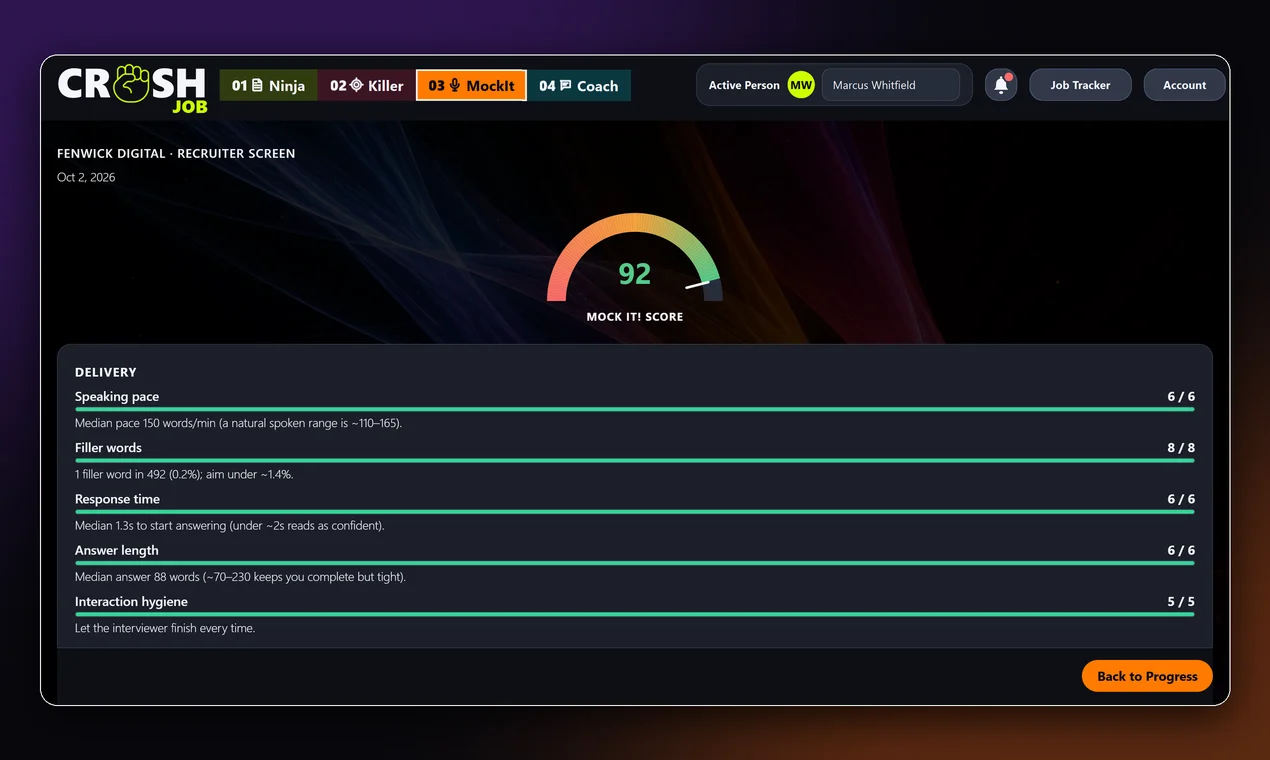
Use the delivery section as a mirror. If your response time is long, practice your pause and restate routine. If filler words are high, replace them with a quiet breath. A score does not predict a real interview, but it shows what to rehearse next. If you want a first taste, you can try a typed mock interview in your browser. It scores what you say, not how you say it.
What else should you know about freezing in an interview?
- What should I do if my mind goes blank in an interview?
- Pause and breathe, then restate the question or ask for a few seconds to think. University career centers say a short pause is acceptable and that restating a question can help you recover.
- Is it okay to ask for a moment to think before answering?
- Yes. Salisbury University's career guide says you can ask for a few seconds to think over your answer. Keep the request short and then answer.
- Can I ask the interviewer to repeat or clarify a question?
- Yes. Duke's career hub, quoting recruiters, says asking for clarification demonstrates critical thinking and avoids wasting time. Ask one specific question, then answer.
- How can I practice so I freeze less?
- Rehearse your stories out loud, practice a pause and restate routine, and run mock interviews with questions you did not choose. Practice builds a routine but cannot promise you will never go blank.
- What does Mock It! score?
- Mock It! scores a spoken mock interview from 0 to 100. Its results screen shows delivery measures such as speaking pace, filler words, response time and answer length.
Practice before your next interview. Choose Interview Ready on the pricing page, with a monthly plan or the matching Get Hired Fast 90-day pass. Early Bird pricing won't last.
For a longer All Access term, the 6-Month All Access Pass is paid once and never renews. Compare all plans and passes.
Get notified about new posts and features
We'll email you when we publish something like this, or ship a new feature. No spam, unsubscribe anytime.