
By Kai Novak, Founder
How long should a job search take?
Cornell's career network says a full-time job search takes two to six months of organized effort. Here is what the federal data shows, and how to plan for your own timeline.
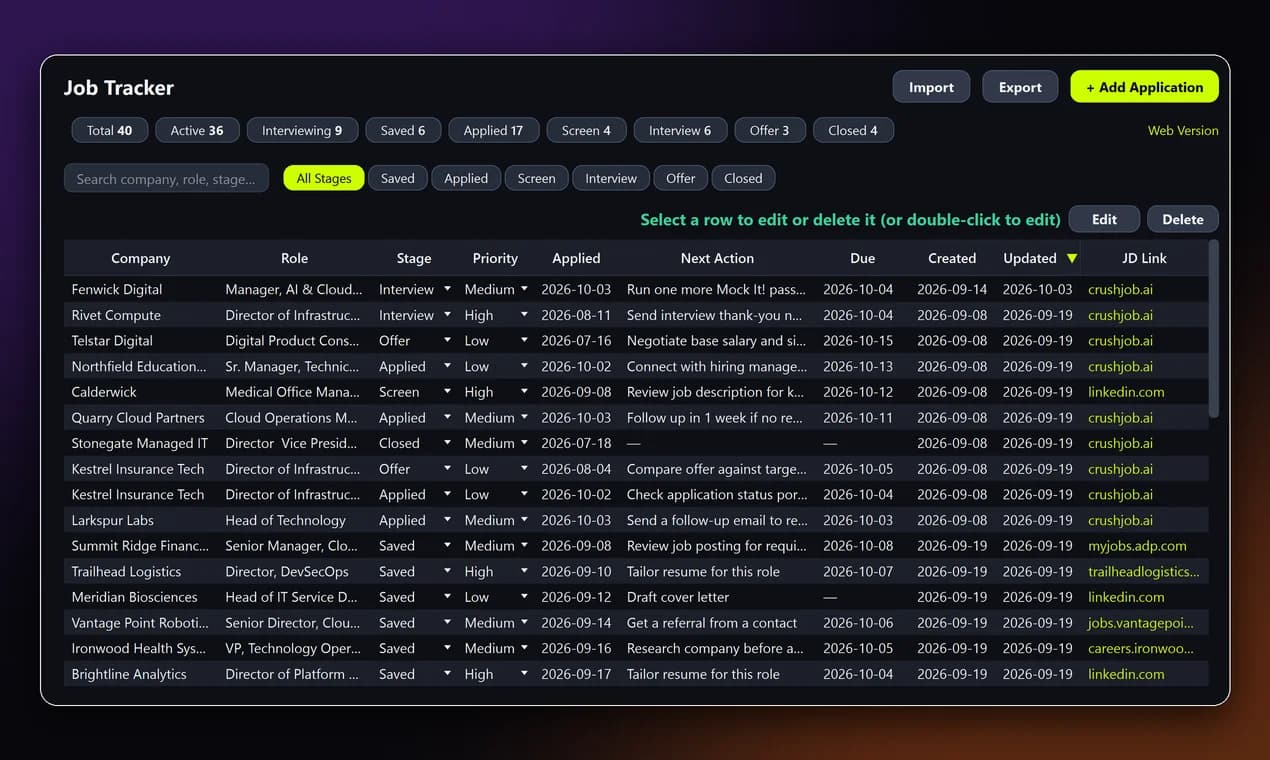
Plan for a few months. Cornell's career network says a full-time job search takes an average of two to six months of organized effort. Your own timeline depends on your field, the season and how much time you put in. Crush Job's desktop app includes a job tracker to keep every application and next step in one list.
Updated .
When a search drags on, it is easy to wonder whether something is wrong. Often nothing is. Hiring has many steps, and some of them sit outside your control. This guide gives you a realistic range, explains what the federal numbers do and do not tell you, and shows how to plan a search you can keep up for months.
How long does a job search usually take?
Expect a few months, not a few weeks. A full-time search often runs longer than people plan for, and that is normal.
Cornell's career network puts it plainly: “A search for a full-time job takes an average of two to six months of organized effort.” Source checked November 2, 2026. Note the words “organized effort.” The range assumes you are searching on purpose, most weeks, not sending an application now and then.
The same page says your results are shaped by how much time you invest and how many strategies you use. That is useful news. You cannot control how fast an employer moves, but you can control how steady your own effort is.
What do government statistics say about job search length?
They show how long unemployed people have been looking so far, which is a related but different number. Read them as a rough backdrop, not a forecast for you.
The U.S. Bureau of Labor Statistics publishes these figures every month. In its Table A-12, the row “Median duration, in weeks” reads 11.5 for September 2026, seasonally adjusted. The average for the same month was 24.8 weeks. Source checked November 2, 2026. The average is much higher than the median because a smaller group of people has been looking for a long time.
That group is not tiny. The September 2026 jobs report says: “The long-term unemployed accounted for 27.1 percent of all unemployed people.” The report defines long-term as 27 weeks or more. Source checked November 2, 2026.
Why isn't the government number the same as your search time?
Because it measures searches that are still going, not searches that have ended. It also only counts people who are unemployed, so it leaves out anyone searching while they still have a job.
The Bureau of Labor Statistics is direct about this. Its definitions page says these duration measures “should not be interpreted as the length of time it takes someone to find a job”. Source checked November 2, 2026.
So treat 11.5 weeks as a snapshot, not a deadline. If you pass that mark, you have not failed a test. You are simply part of a normal spread of outcomes.
What makes a job search take longer?
Your field, the employer's hiring process and the time of year all play a part. Some sectors hire on a fixed calendar, and some processes simply have more steps.
Yale's Office of Career Strategy notes that “Federal jobs often require advanced planning due to long hiring processes.” Source checked November 2, 2026. The same page shows that some industries recruit far ahead of the start date, so the search starts well before the job does.
Other common reasons a search runs long are within your reach:
- A narrow target. Only applying to a handful of employers means fewer chances.
- Generic applications. Sending the same resume everywhere can make it harder to show you fit a specific role.
- No follow-up. Applications without a next step tend to go quiet.
- Stop-start effort. A burst of activity, then two weeks off, slows everything.
This list is our practical advice, not a finding from the sources above. Use it as a checklist, not a diagnosis.
How can you plan a job search timeline?
Set a weekly routine, not a finish date. You cannot schedule an offer, but you can schedule the work that leads to one.
A simple plan looks like this:
- Pick your targets. Choose the roles and a list of employers you would be glad to work for.
- Set a weekly goal. Decide how many tailored applications and networking messages you will send each week.
- Track every application. Log the company, role, date, resume version and next step in one place.
- Follow up on a date. Give every application and contact a next-step date, and act on it.
- Review every few weeks. Look at where applications stall, and adjust the stage that is weakest.
If you need a system for step 3, see the best way to track your job applications. It covers which columns to keep and how to keep the list current.
Crush Job's desktop app includes a job tracker. If you cancel a paid plan, you keep your application tracker. A spreadsheet can do the same core job if you update it as things happen.
How do you know if your search is working?
Look at where applications stop moving, not only at how long you have been looking. Stage counts tell you what to fix next.
If you send many applications but get few first calls, your resume and targeting are the place to start. Tailoring your resume to each posting is one way to show fit. See does resume tailoring actually work for what it can and cannot do. If you get interviews but no offers, spend your time on interview practice instead. Our guide on how to stop freezing up in an interview is a good place to start.
This is why tracking matters for timing. A tracker turns a vague sense that “nothing is happening” into a clear picture of which stage is stuck.
How do you stay motivated during a long search?
Measure the things you control, such as applications sent and follow-ups made, and count those as progress. Offers come on the employer's schedule, but effort comes on yours.
Keep a fixed search schedule, and protect time off. A steady pace you can keep for months beats a sprint that burns out in two weeks. If you have access to a career center, ask an advisor to review your plan.
What else should you know about how long a job search takes?
- How long does it take to find a job?
- Plan for a few months. Cornell's career network says a full-time job search takes an average of two to six months of organized effort, and your field and timing can move that range.
- What is the average length of unemployment in the US?
- In September 2026, the Bureau of Labor Statistics reported a median of 11.5 weeks and an average of 24.8 weeks, seasonally adjusted. These count searches still in progress, so they are not a measure of how long it takes to find a job.
- Is a six-month job search normal?
- It can be. Six months sits at the top of Cornell's two-to-six-month range, and the Bureau of Labor Statistics reported that 27.1 percent of unemployed people in September 2026 had been looking for 27 weeks or more.
- How can I speed up my job search?
- Set a weekly routine, tailor each application, follow up on a set date, and track where applications stall. Fix the weakest stage first rather than only sending more applications.
- Does Crush Job include a job tracker?
- Yes. Crush Job's desktop app includes a job tracker, and if you cancel a paid plan you keep your application tracker.
Keep every application and next step in one place. See the plans on the pricing page, including the Free plan, which needs no card.
Get notified about new posts and features
We'll email you when we publish something like this, or ship a new feature. No spam, unsubscribe anytime.